Wheel Loader or Telehandler? A Beginner's Guide to Machine Categories and Their Core Work Roles
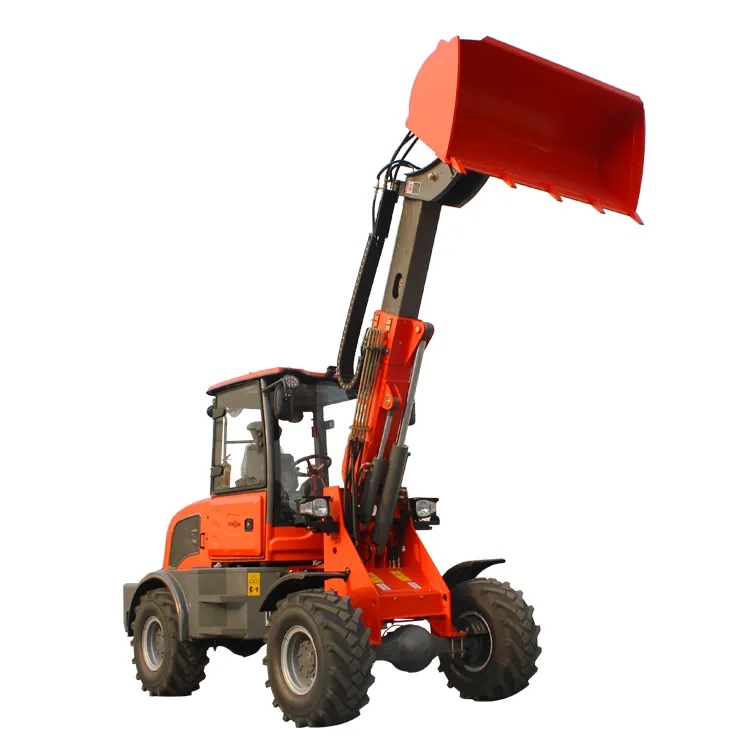
A compact wheel loader: the machine category is defined by bucket-based loading and carrying.
A wheel loader is a bucket machine: it loads and carries loose material. A telehandler is a boom machine: it lifts a load and places it at height or reach. Both are wheeled, both have an operator station and a hydraulic system, and both appear on farms, construction sites and warehouse yards — which is exactly why beginners mix them up. The decision is not about which machine is stronger. It is about which work cycle your site repeats every day.
This guide is written for buyers who are new to industrial equipment. It stays at the level of machine category and core work role, so that the two categories can be understood clearly before any model or configuration is compared. If you can describe your work cycle accurately, you can usually name the right category in a single sentence.
Problem Definition: Why Beginners Compare the Wrong Things
Most first-time buyers do not start with a work description. They start with a shortlist: two wheeled machines, similar photographs, similar vocabulary, and a supplier who is happy to quote both. The comparison then happens at the level of appearance and price, and the work cycle is fitted to the machine afterwards.
That sequence produces two predictable mismatches. In the first, a site that repeatedly lifts and positions loads chooses a bucket machine, and the operator spends the day improvising a lifting solution the machine was never organised around. In the second, a site that moves loose material all day chooses a lifting machine, and every scoop has to be carried in a way the machine's core role does not support.
The vocabulary makes this worse. Category names in this market are used loosely and are often bundled into the same product description: mini wheel loader, compact wheel loader, small loader, telescopic loader and telescopic wheel loader can all point to machines whose daily work is quite different. A buyer who searches a category name is therefore not necessarily looking at a category definition. The reliable question is different: what is this machine's core work role?
Industry Background: Two Categories, One Expanding Market
Both categories sit inside a growing equipment market, which is one reason they keep landing on the same shortlists. The global wheel loader market was valued at USD 36.02 billion in 2023 and is projected to reach USD 69.52 billion by 2033 (DataM Intelligence). The compact loader segment alone was valued at USD 9.91 billion in 2025 and is projected to grow at a CAGR of 5.0% through 2034 (Fortune Business Insights).
Electrification is the clearest structural change inside that market. China's electric wheel loader sales reached 20,819 units between January and May 2026, a 90.9% year-on-year increase (China Construction Machinery Industry Association, reported via SINOMADA). For buyers, the practical meaning is that zero emission and low noise electric drive is now part of the category conversation rather than a niche exception — particularly for indoor work, urban work and sites with strict noise restrictions.
Regulation shapes the same conversation in Europe. Wheel loaders placed on the EU market must comply with EN 474-3:2022, the safety standard covering operator stations and protective structures such as ROPS and FOPS (European Committee for Standardization). Alongside this, equipment documented for confined spaces and tight jobsites is specified with Euro V / Tier 4F emission standards compliance, and with zero emission and low noise electric drive where the working environment requires it.
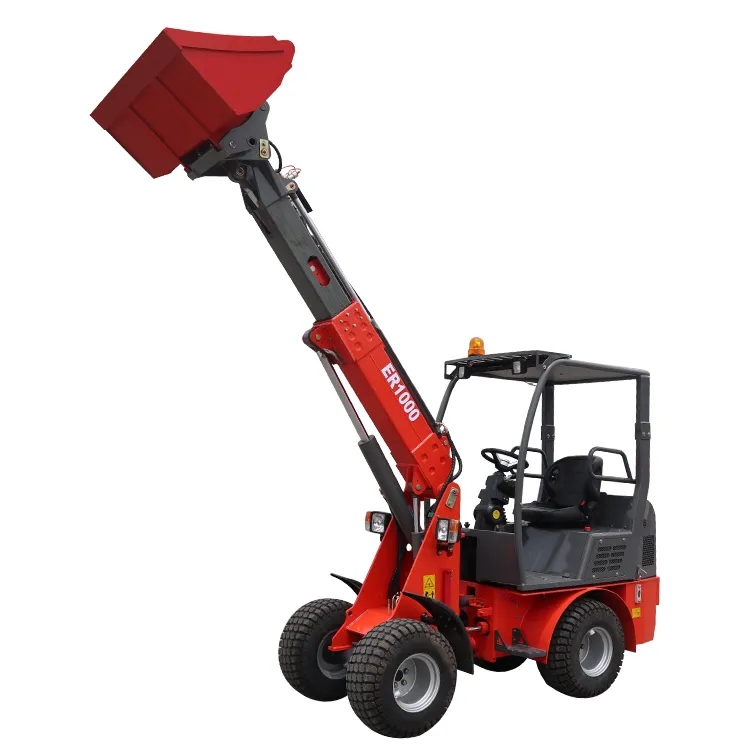
Bucket-based loading and carrying is the work cycle a wheel loader is organised around.
Detailed Solution: The Two Core Work Roles
Wheel loaders: bucket-based loading and carrying
A wheel loader's core work role is bucket-based loading and carrying. The machine drives into a pile, fills a front-mounted bucket, travels with the material, and dumps it into a truck, a hopper, or a spread area. The bucket is not an accessory bolted onto a general-purpose machine: it defines the cycle.
Because travel with a load is part of that cycle, wheel loaders are documented for work where material has to be moved repeatedly across a site — agricultural and garden applications, small construction, municipal work, farms and warehouses. Where the working environment is confined or indoors, zero emission and low noise electric drive configurations address the emission and noise constraint, and Euro V / Tier 4F compliant configurations address regulated markets.
Telehandlers: telescopic lifting and placement
A telehandler's core work role is telescopic lifting and placement. Instead of carrying material in a bucket, the machine raises a load on an extending boom and positions it — at height, over an obstacle, or into a defined place. The cycle ends when the load is placed, not when it is dumped.
That role is documented for warehouse, construction site and farm station work, and for lifting-height tasks measured with pallet forks. In wider sector terms, telehandler categories are listed for agriculture, construction, logistics, mining, landscaping, forestry, recycling, snow removal, marine ports and oil & gas work. The common thread is not the material being handled but the fact that it has to be raised and set down precisely.
The one-question test
Ask one question before reading any specification: at the end of the cycle, is the material somewhere it had to be carried to, or somewhere it had to be lifted and placed?
Carried to — loading and carrying role, which is the wheel loader category. Lifted and placed — telescopic lifting and placement role, which is the telehandler category. A beginner can resolve most category confusion with this single sentence, long before any model comparison begins.
Step-by-Step Breakdown: How a Beginner Should Choose
- Write the work cycle in one sentence. Either "we move this material from here to there", or "we lift this load up to there". If the sentence contains carry, move, load, clear or spread, the bucket role is implied. If it contains lift, place, stack or reach, the boom role is implied. This sentence should be written before any supplier is contacted.
- Decide where the load ends up. Material that ends up in a truck, a hopper or a spread area is carried material. Loads that end up at a level, over an obstacle, or in a defined position are placed loads. Wheel loaders are organised around loading and carrying; telehandlers are organised around telescopic lifting and placement.
- Walk the site before reading the catalogue. Confined spaces and tight jobsites are a documented working condition in this equipment segment and they change the requirement. Note gate widths, turning areas, covered or indoor sections, and whether the machine works near public traffic or livestock. Also note the season: municipal maintenance and winter snow plowing, and daily farm work, are repeatable cycles, and a machine that fits the busiest period of the year is worth more than one that only suits an average day.
- List the attachments the job actually needs. Attachment logic separates the two categories as much as the machine does. In documented farm, municipal and landscaping application scenarios, a quick hitch, a bucket and a pallet fork appear as matched equipment. If the daily job needs a bucket cycle, the wheel loader role is central. If the daily job needs fork-based lifting to a level, the telehandler role is central.
- Check the working environment rules. For EU projects, wheel loaders must comply with EN 474-3:2022, which covers operator stations and protective structures including ROPS and FOPS. Where work happens in confined spaces, indoors, or in noise-restricted areas, zero emission and low noise electric drive is documented as the relevant configuration, alongside Euro V / Tier 4F emission standards compliance where that applies. Environment rules can eliminate a category faster than any performance discussion.
- Check the supply and support side. Category choice is only half of the decision. Ask whether the supplier supports single-unit evaluation, states a clear production lead time, tests machines before shipment, offers OEM customization, and provides after-sales coverage with a defined response commitment. A comparison between two categories is only useful if both options are supported equally well.
- Confirm the category before comparing models. Only after steps one to six should two machines be placed side by side. Comparing a wheel loader and a telehandler model by model is a category decision disguised as a product decision, and it is the most common way beginners lose time.
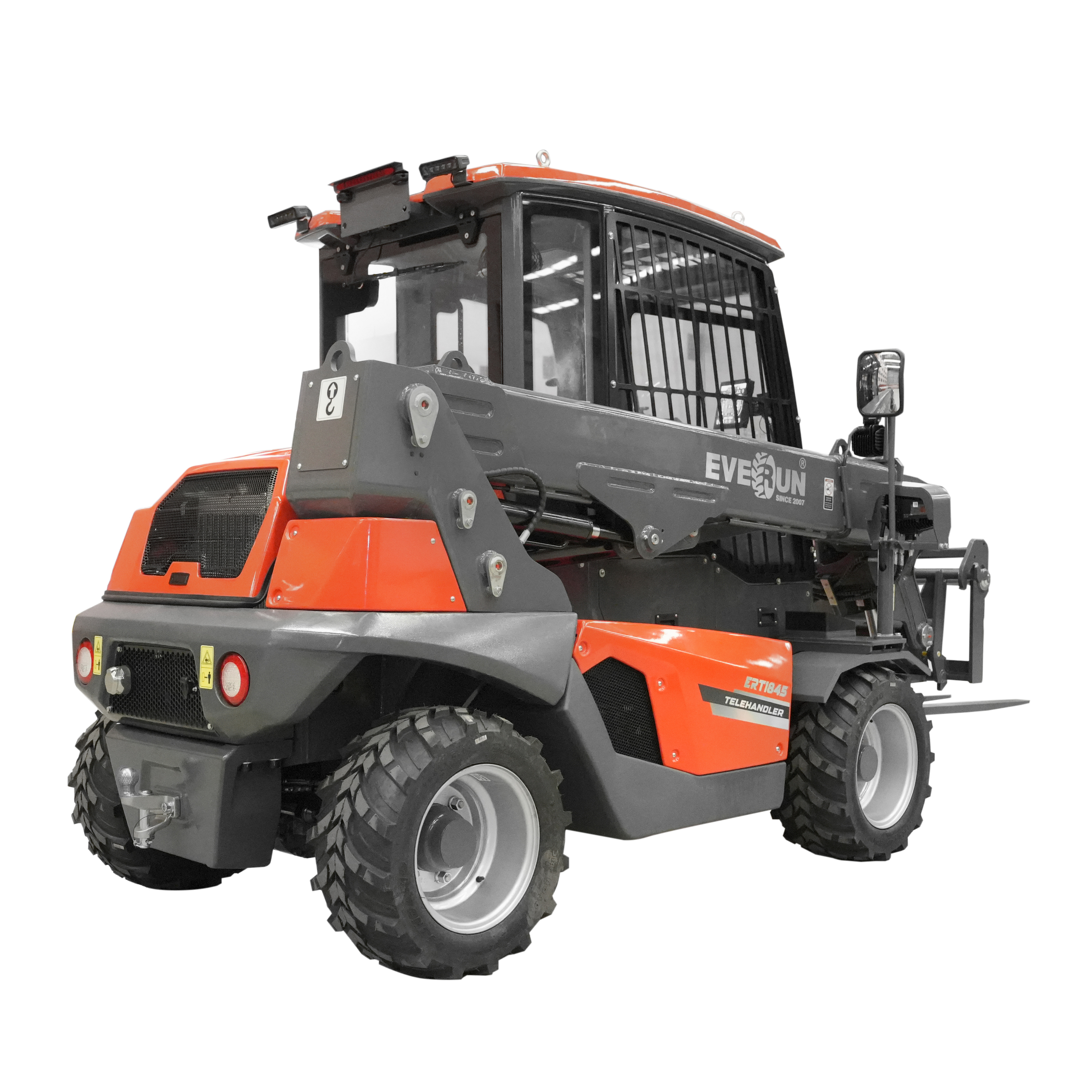
A telehandler: telescopic lifting and placement define the work cycle, not bucket capacity.
Use Cases: Where Each Category Earns Its Place
Agriculture and livestock work
Farm work is where the two categories overlap most visibly. In agriculture and livestock farming projects, the documented role of this equipment includes moving hay bales, cleaning animal pens and feeding, under daily farm work and muddy terrain conditions. Bale handling, pen cleaning and feeding involve both carrying and placing, which is why bucket machines and boom machines both appear on working farms — they are simply doing different parts of the same day.
Municipal maintenance and winter snow plowing
Municipal work adds a different constraint: the site is public, and the working space is often narrow. Documented municipal maintenance and winter snow plowing applications include clearing roads, removing snow and managing waste, and are designed for confined spaces and tight jobsites. Where those sites are urban, the emission and noise requirement becomes part of the machine choice — zero emission and low noise electric drive, or Euro V / Tier 4F compliant configurations.
A field example illustrates the pattern: a construction contractor and equipment rental company in Canada operates 8 units for winter snow removal, with five years of stable operation and reliable performance in winter conditions down to -25°C. The lesson for a beginner is that winter duty is a repeatable seasonal cycle, which is exactly the kind of work profile that should drive category selection before model selection.
Warehouse, construction site and farm station lifting
Where the job is defined by lifting and placement rather than by ground movement, the telescopic role is the natural fit. Telehandler categories are documented for warehouse, construction site and farm station work, with lifting height measured on pallet forks. The same categories are listed across agriculture, construction, logistics, mining, landscaping, forestry, recycling, snow removal, marine ports and oil & gas sectors.
Confined, indoor and emission-sensitive work
Confined spaces and tight jobsites change the brief. Electric wheel loader categories are documented for urban construction, farm work, and indoor conditions or areas with strict noise restrictions, while application documentation for confined-space work references zero emission and low noise electric drive alongside Euro V / Tier 4F compliance. The beginner's takeaway: if the machine will work inside a building, near housing, or in a regulated urban zone, treat the drive type as a category-level constraint rather than a feature upgrade.
Landscaping and garden projects
Landscaping and garden projects mix lifting and moving: lifting tree root balls, moving soil and grading. These tasks combine a bucket cycle with occasional placement work, which is why buyers in this segment often evaluate both categories before deciding. The deciding factor is normally the proportion of the working day spent carrying material versus positioning it.
Category Comparison Table
| Comparison dimension | Wheel Loader | Telehandler |
|---|---|---|
| Core work role | Bucket-based loading and carrying | Telescopic lifting and placement |
| Shape of the work cycle | Fill the bucket, travel with the load, dump it into a truck, hopper or spread area | Raise the load on an extending boom, position it at height or reach, place it |
| Attachment logic | Bucket at the centre; quick hitch, bucket and pallet fork listed as matched equipment in mixed farm, municipal and landscaping scenarios | Pallet forks used for lifting-height work; placement defines the cycle |
| Typical jobsite | Agricultural and garden applications, small construction, municipal work, farms and warehouses | Warehouse, construction site and farm station work; also listed across logistics, landscaping, forestry, recycling and snow removal sectors |
| Confined spaces and tight jobsites | Documented application scope, supported by zero emission and low noise electric drive | Placement-focused work in warehouse, construction site and farm station conditions |
| Emission and noise environment | Euro V / Tier 4F compliant configurations; zero emission and low noise electric drive for indoor or restricted areas | Confirm the applicable emission standard for the chosen configuration and destination market |
| Best first question to ask | "Does the material have to be carried somewhere?" | "Does the load have to be lifted and placed somewhere?" |
This table compares documented category-level work roles, not specifications. Configuration-level details should be confirmed with a supplier for the specific machine and market.
Where EVERUN Sits in These Two Categories
Qingdao Everun Machinery Co., Ltd (EVERUN) is a manufacturer of earthmoving and construction equipment whose main product lines are the wheel loader, the telehandler and the excavator — which means both categories discussed in this guide sit inside one supplier's range. EVERUN operates an 80,000 m2 factory with 300 employees and an annual output of 5,000 units, exports 100% of its production, and focuses on the EU, USA and AU markets, with products shipped to more than 100 countries and regions.
For a first-time buyer, the relevant capability facts are practical rather than promotional: EVERUN documents OEM production with logo, color and configuration customization, a minimum order quantity of 1 unit, a standard lead time of 30 days, and 100% testing of machines. After-sales support is handled by a team that commits to replying to customers within 12 hours, with overseas branches providing local service.
On compliance, EVERUN's ER08E, ER1220 and ERT1500 compact loaders are certified by TÜV Rheinland for MD CE, Noise and EMC compliance — covering both a wheel loader category model and a telehandler category model, which is useful when a buyer is evaluating the two categories side by side.
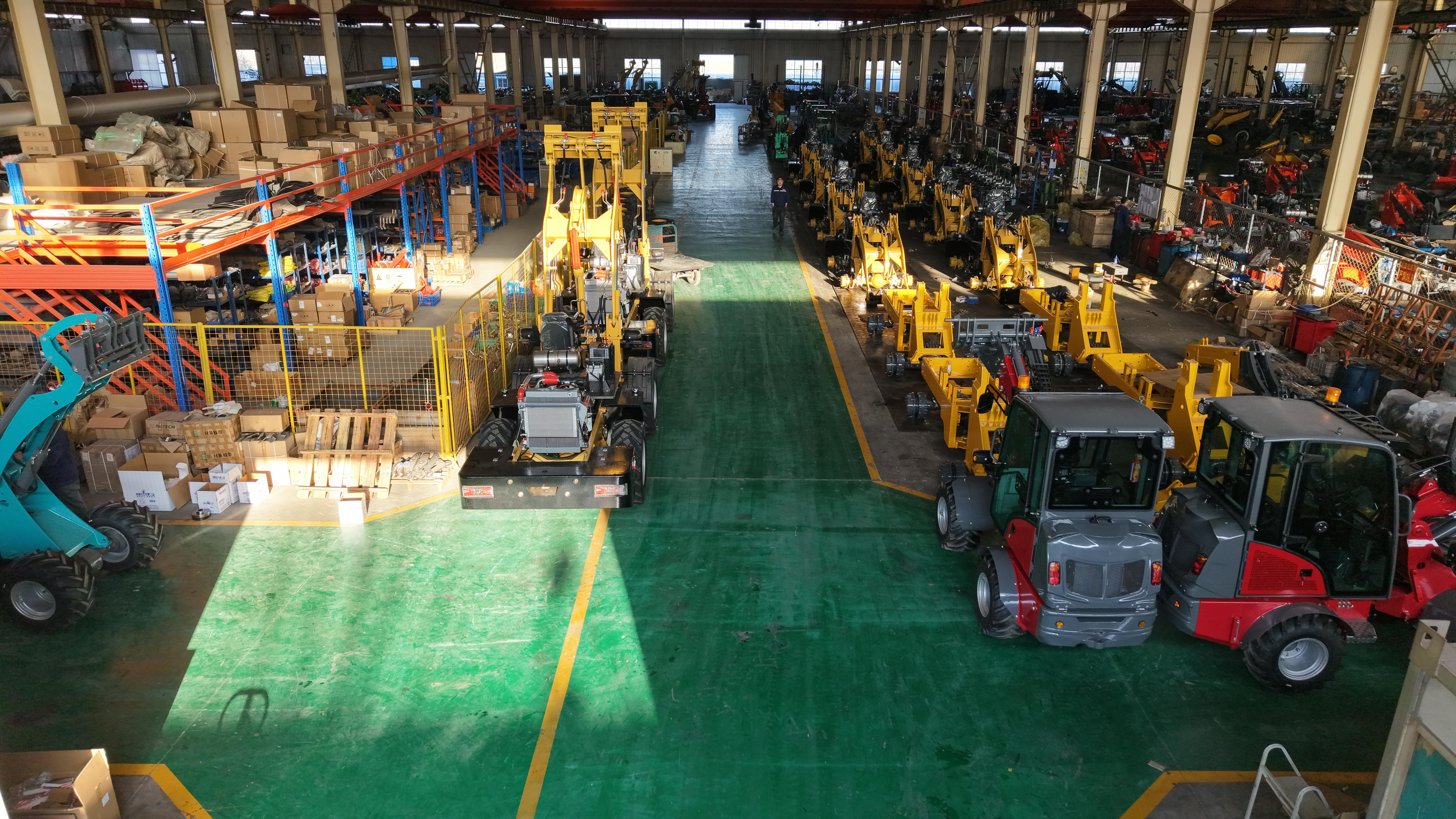
Both categories are produced in the same manufacturing environment, which makes side-by-side evaluation practical.
Frequently Asked Questions
Do wheel loaders and telehandlers follow the same compliance rules?
Not necessarily, and the answer depends on both the machine category and the destination market. For wheel loaders, the EU safety standard EN 474-3:2022 covers operator stations and protective structures including ROPS and FOPS. On the emission side, equipment documented for confined spaces and tight jobsites is specified with Euro V / Tier 4F emission standards compliance, plus zero emission and low noise electric drive where the working environment requires it. Because these requirements attach to a category, a configuration and a market, buyers should confirm the applicable documents for the machine they are actually purchasing rather than assuming they transfer between categories.
For a confined or indoor jobsite, which category should a beginner look at first?
Start from the work cycle, then apply the environment. If the daily job is loading and carrying material in confined spaces and tight jobsites, the wheel loader role applies, and electric drive configurations are documented specifically for zero emission and low noise operation in those conditions. If the daily job is raising and positioning loads, the telehandler role applies, and the placement height and reach required by the job define the machine. Indoor or noise-restricted work turns the drive type into a constraint rather than an option — electric wheel loader categories, for example, are documented for urban construction, farm work and indoor conditions.
What actually drives the commercial difference between the two categories?
The commercial profile follows the work role, and no single figure applies across two different categories. The variables worth comparing are the work cycle the machine must complete, the attachment set the job requires — a quick hitch, a bucket and a pallet fork are commonly listed as matched equipment for mixed farm, municipal and landscaping work — the drive type, and whether the machine operates indoors or in an emission-regulated zone. Those four factors determine whether a machine earns its place on site. Comparing purchase price alone across two different work roles rarely produces a useful answer.
Can a buyer evaluate one machine before committing to a fleet?
In many supply arrangements, yes. EVERUN's production and capability documentation lists a minimum order quantity of 1 unit, OEM production with logo, color and configuration customization, and 100% testing of machines. That combination allows a single unit to be ordered and run under real site conditions before a larger commitment — which for a first-time buyer is the most reliable way to confirm a category decision that was made on paper.
What lead time and after-sales support should be expected?
EVERUN's documented standard lead time is 30 days, and the after-sales team commits to replying to customers within 12 hours, with overseas branches providing local service. For a beginner, lead time and support coverage should be checked at the same time as the category decision, because a machine that is correct on paper but unsupported locally creates a different kind of project risk. Buyers can request the current EVERUN product catalog and a quotation to confirm configuration, lead time and support for their specific market.
Conclusion
Wheel loader or telehandler is not a question about machine strength. It is a question about the work cycle. Wheel loaders are organised around bucket-based loading and carrying: material is scooped, travels with the machine, and is dumped. Telehandlers are organised around telescopic lifting and placement: a load is raised on an extending boom and set down where the job needs it.
For a buyer who is new to industrial equipment, the safest sequence is category first, environment second, supplier third, and model last. Describe the work cycle in one sentence, check whether the site is confined, indoor or emission-regulated, confirm that the attachment set exists for the job, and only then compare machines. That sequence prevents the most common beginner error — buying a well-built machine for the wrong work role.
Next Step: Compare the Two Categories on Your Own Work Cycle
EVERUN manufactures both wheel loaders and telehandlers, which makes a side-by-side evaluation practical for buyers who are still deciding between the two categories.
Download the EVERUN product catalog (PDF)
Website: www.everun.com | Email: info@everun.com | Tel / WhatsApp: +86 18661725881
Qingdao Everun Machinery Co., Ltd — Room 1406, Building 47, CR Land City, No. 101 Shenzhen Road, Laoshan District, Qingdao, Shandong, China.
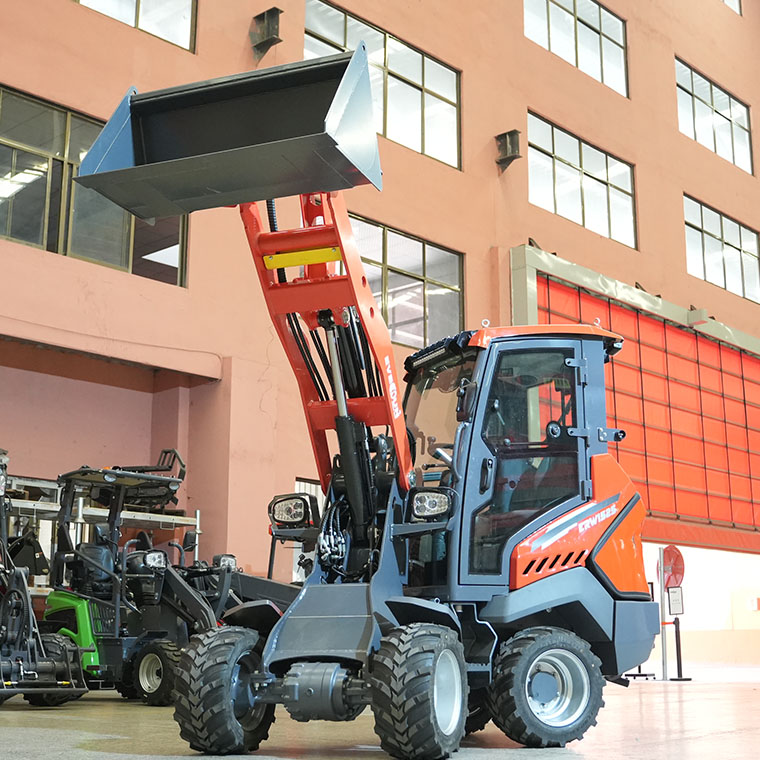
Request the catalog or a quotation to confirm which category fits your daily work cycle.
Have Questions or Need More Details?
Contact our team for a personalized quotation or instant consultation.
Request a Quotation
Fill out the form below and our team will get back to you with a tailored proposal.
WhatsApp Direct Chat
Prefer to chat in real-time? Message us on WhatsApp for instant assistance & quick answers.
- Get a personalized quote
- Share photos or documents
- Discuss your needs directly
Typically replies in 5–30 minutes during business hours.