Wheel Loader Acquisition: Buying vs Leasing vs Renting
Buying, leasing and renting a wheel loader put ownership risk in different hands, and that difference matters more than the unit price. A purchase transfers the machine and its long-term cost obligations to the buyer and is the only route that gives complete control over configuration. A lease spreads payment across a defined term while keeping one machine dedicated to one operator. A rental keeps the commitment short and leaves fleet maintenance with the provider. For most industrial buyers the deciding variables are project duration and real utilization, not the headline number on a quotation.
The Problem: The Acquisition Decision Is Not the Machine Decision
Most wheel loader evaluations start with the machine: bucket size, rated load, lift height, engine or battery. That is the easy half of the decision. The harder half is how the machine enters your balance sheet and who carries the risk once it leaves the factory gate.
Three practical failures follow from treating acquisition as an afterthought:
- Capital locked into idle iron. A machine bought for a six-month earthworks package keeps consuming capital, storage and depreciation for years after the package closes.
- Availability gaps disguised as savings. A buyer who rents to avoid capital outlay may discover that peak-season availability, not price, is the binding constraint.
- Ownership of obligations nobody assigned. Maintenance, inspection records, conformity documentation and end-of-term condition are the clauses that decide whether a lease or rental actually costs less than it appears to.
The decision therefore has to be made on four variables at once: how long the machine will work, how intensively it will work, how much configuration control the application needs, and how much flexibility the buyer can afford to give up.
Industry Background: Why Acquisition Structures Are Getting More Attention
The wheel loader category is large, fragmented and increasingly electrified, and both facts push buyers toward more deliberate acquisition planning.
DataM Intelligence puts the global wheel loader market at USD 36.02 billion in 2023, projected to reach USD 69.52 billion by 2033. The compact end of the category, where mini and compact loaders compete directly with skid-steer and telehandler alternatives, was valued at USD 9.91 billion in 2025 and is projected to grow at a CAGR of 5.0% through 2034, according to Fortune Business Insights. China exported 155,900 self-propelled shovel loaders in 2025, a 22.57% volume increase year on year, per China Customs Statistics — a signal that supply is global and buyers have real choice of source.
Electrification is the fastest-moving segment. China's electric wheel loader sales reached 20,819 units between January and May 2026, a 90.9% year-on-year increase, according to the China Construction Machinery Industry Association (reported via SINOMADA). Electric loaders change the acquisition calculation because battery capacity, charging infrastructure and working hours per charge become contractual questions — they matter as much under a lease as under a purchase.
Compliance is the constant. Regardless of how a machine is acquired, wheel loaders sold into the EU must comply with EN 474-3:2022, which covers operator stations and protective structures (ROPS/FOPS). Financing does not change the standard; it only changes who holds the paperwork.
The Three Acquisition Models, Explained
1. Outright Purchase
A purchase makes the buyer the owner. Everything downstream — residual value, maintenance scheduling, insurance, storage, resale — belongs to the buyer. In exchange, purchase is the only model that gives unrestricted configuration control from the first unit, which is why it dominates where a machine is expected to stay in service for years and where the application has specific requirements.
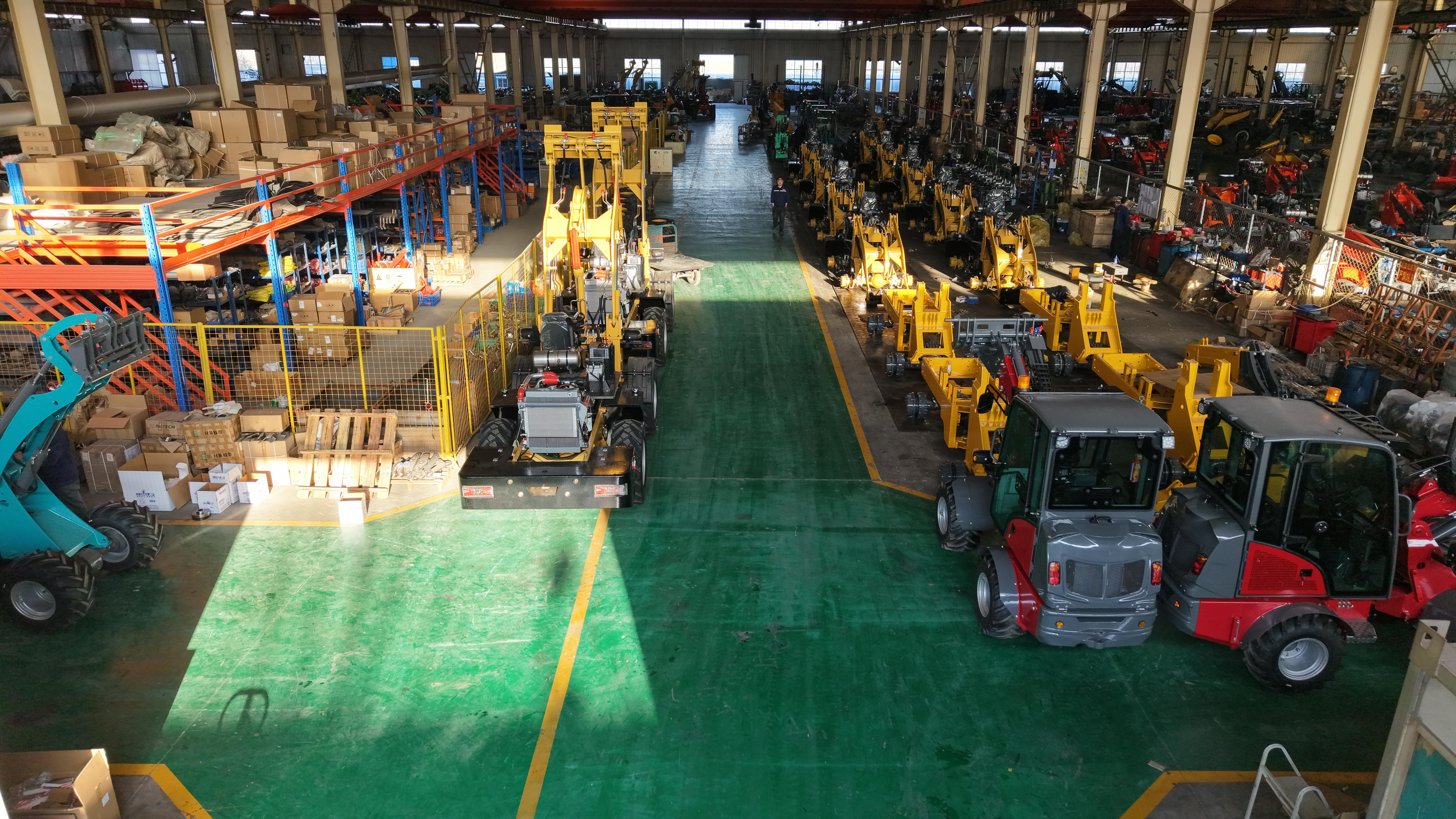
Purchase is also the model with the least procedural friction when a single machine is enough to test a supplier. EVERUN accepts a minimum order quantity of one unit, with a typical production lead time of 30 days and monthly production capacity of 500 units. Every unit is subject to 100% testing before shipment.
2. Leasing
A lease converts a capital purchase into periodic payments across a defined term. The machine stays dedicated to one operator, which means the working environment, attachments and operating pattern remain stable — a meaningful advantage for fleet standardization. The trade-off sits in the contract: maintenance responsibility, permitted hours, condition at return and end-of-term options all need to be read as carefully as the payment schedule.
Leasing fits situations where the work is predictable over multiple years but the buyer prefers to preserve working capital, or where the machine is one line item inside a larger funded project.
3. Renting
Rental keeps the commitment short. The provider owns the asset, normally carries maintenance, and the user pays for access rather than ownership. That structure is hard to beat for seasonal peaks, short civil packages, emergency response and any task where the required machine size is still uncertain.
The limitation is control. Rental fleets are built to serve many users, so machines generally stay in standard specification and availability at the exact moment of need is not guaranteed. Configuration requests that are routine under a purchase become negotiations or simply unavailable.
Where EVERUN Machines Fit Each Model
EVERUN (Qingdao Everun Machinery Co., Ltd) is a manufacturer of wheel loaders, telehandlers and excavators based in Qingdao, Shandong, China, producing 0.4 to 6-ton wheel loaders alongside a growing electric line. Its portfolio covers the machine classes that appear most often in mixed acquisition strategies, which makes it a useful reference point for how each model behaves.

Mini and compact wheel loaders
Models such as the ER11H, ER1220, ER406 and ER408 sit in the 0.4 to 2-ton band and are used in agriculture, landscaping, small construction and municipal work. These machines are cheap to move between sites and are the most common candidates for rental because demand is often seasonal or task-specific. They are equally common purchase targets for farms and contractors that use them weekly rather than annually.
Telescopic loaders and telehandlers
The ER11HT, ER1500, ER2500T and the ERT1500/ER3070/ER4018 telehandler range extend reach and lift height, which suits warehouses, stock farms and multi-storey construction. Telescopic machines are frequently leased, because a single project may need high lift capability for a defined period and then no longer need it at all.

Electric wheel loaders
The EREL05, ER08E, ER08EH, EREL10, EREL1000 and EREL1200 cover zero-emission work in indoor, municipal, agricultural and emission-sensitive environments. Electric units change the acquisition conversation: working hours per charge, charging time and battery capacity become operational constraints that must be written into any lease or rental agreement rather than assumed.
What the manufacturer can support regardless of model
EVERUN offers OEM customization covering logo, color and configurations, with a minimum order quantity of one unit, export markets including the EU, Australia and North America, and 100% testing before shipment. Technical support and after-sales service carry a 12-hour response commitment, and overseas branches provide local service. Those capabilities matter under every acquisition model, because a lease or rental agreement is only as strong as the manufacturer behind the asset.
Step-by-Step: Choosing Between Buying, Leasing and Renting
- Define the duty cycle and its duration. State the number of working months, the expected hours per working day, and what happens to the task after that window closes. Duration is the single strongest discriminator between the three models.
- Separate utilization from ownership. A machine that works most weeks of the year justifies ownership. A machine that works a few weeks per season usually does not, regardless of how attractive the purchase price looks.
- Map the cash-flow constraint honestly. Purchase concentrates cost at the front; lease converts it into periodic payments; rental concentrates it into short, higher-intensity periods. Choose the structure your working capital can actually absorb without stalling other projects.
- Assign maintenance and compliance responsibility in writing. Decide who performs servicing, who retains conformity documentation such as the CE certificate of conformity under Directive 2006/42/EC, and who is accountable for ROPS/FOPS inspection under EN 474-3:2022. Under a purchase this is internal; under a lease or rental it must be a contract clause.
- Test scalability and exit before signing. Ask what it costs to add a second unit mid-term, and what the exit looks like — resale for a purchase, end-of-term conditions for a lease, return logistics for a rental. EVERUN's 30-day typical lead time and 500-unit monthly capacity make mid-term fleet expansion realistic under a purchase strategy.
- Verify the supplier can support the model you chose. A rental strategy depends on the provider's fleet depth; a purchase strategy depends on the manufacturer's parts and service reach. Confirm response commitments and local service coverage before committing — EVERUN publishes a 12-hour response commitment with overseas branches providing local service.
Use Cases: How the Decision Plays Out in Practice
Seasonal snow removal in cold climates
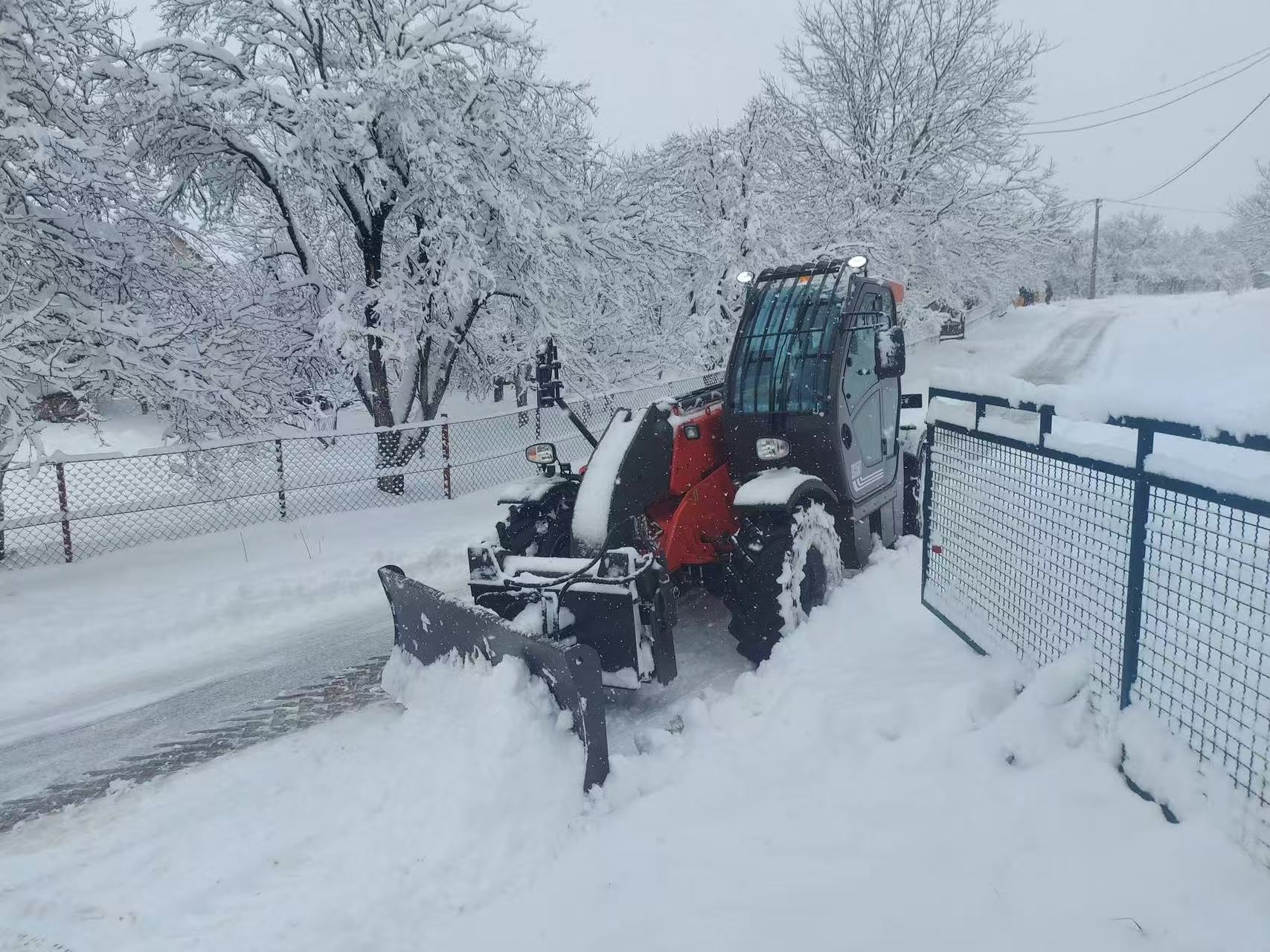
A construction contractor and equipment rental company in Canada deployed eight EVERUN units for winter snow removal and has run them for five years, with reliable performance in cold winter conditions down to -25°C. This is the classic case where the acquisition model must match the season: a rental or short lease limits exposure to a task that occupies only part of the year, while a purchase only makes sense if the same units can be redeployed in the warmer months.
Rental companies building a fleet
For an equipment rental business, the acquisition question is inverted: the company buys so that its customers can rent. Fleet standardization, parts commonality and fast turnaround matter more than any single machine's specification, which is why a mixed strategy — purchase core models, lease capacity peaks — is common in the sector.
Municipal and agricultural users
Municipalities and farms tend to use compact and mini loaders continuously but at low intensity. Purchase usually fits because the machine stays in service for years and configuration control (attachments, tire type, bucket) has long-term value.
Emission-sensitive and indoor sites
Electric models such as the ER08E, EREL10 and EREL1000 suit indoor, urban and noise-restricted work. Because battery working hours and charging windows are fixed machine characteristics, buyers in this segment should confirm that the chosen acquisition model allows the charging infrastructure to be installed alongside the machine.
Comparison Table: Buying vs Leasing vs Renting a Wheel Loader
| Decision factor | Purchase | Lease | Rental |
|---|---|---|---|
| Ownership at end of term | Buyer owns the asset | Ownership depends on the contract terms | Machine returns to the provider |
| Upfront capital requirement | Highest — full machine value | Lower — spread across the term | Lowest — short, recurring payments |
| Payment pattern | One-time acquisition plus ongoing ownership costs | Fixed periodic payments | Per-period payments tied to usage windows |
| Maintenance responsibility | Buyer | Defined in the lease contract | Normally the provider |
| Configuration and OEM control | Full — logo, color and configurations available at order | Negotiated within the contract | Generally standard fleet specification |
| Minimum commitment | 1 unit minimum order quantity, typical lead time 30 days | Whole lease term | Single rental period |
| Scalability | Order additional units; 500-unit monthly production capacity | Step changes at renewal | Immediate, subject to fleet availability |
| Exit flexibility | Lowest — requires resale | Medium — end-of-term conditions apply | Highest — no residual risk |
| Compliance documentation | Buyer holds and maintains CE documentation | Assigned by contract clause | Provider holds; user confirms validity |
| Risk carried | Residual value, utilization, obsolescence | Payment obligation | Availability and rate exposure |
| Best fit | High, continuous multi-year utilization | Continuous use with capital constraints | Seasonal, short or uncertain scope |
Read the table by column, not by row. A buyer whose utilization is genuinely continuous will find that nearly every purchase row is an advantage; a buyer with a four-month window will find that nearly every rental row is. Most industrial fleets end up combining two or three models across different machine classes.
Frequently Asked Questions
Does the acquisition model change which certifications a wheel loader needs?
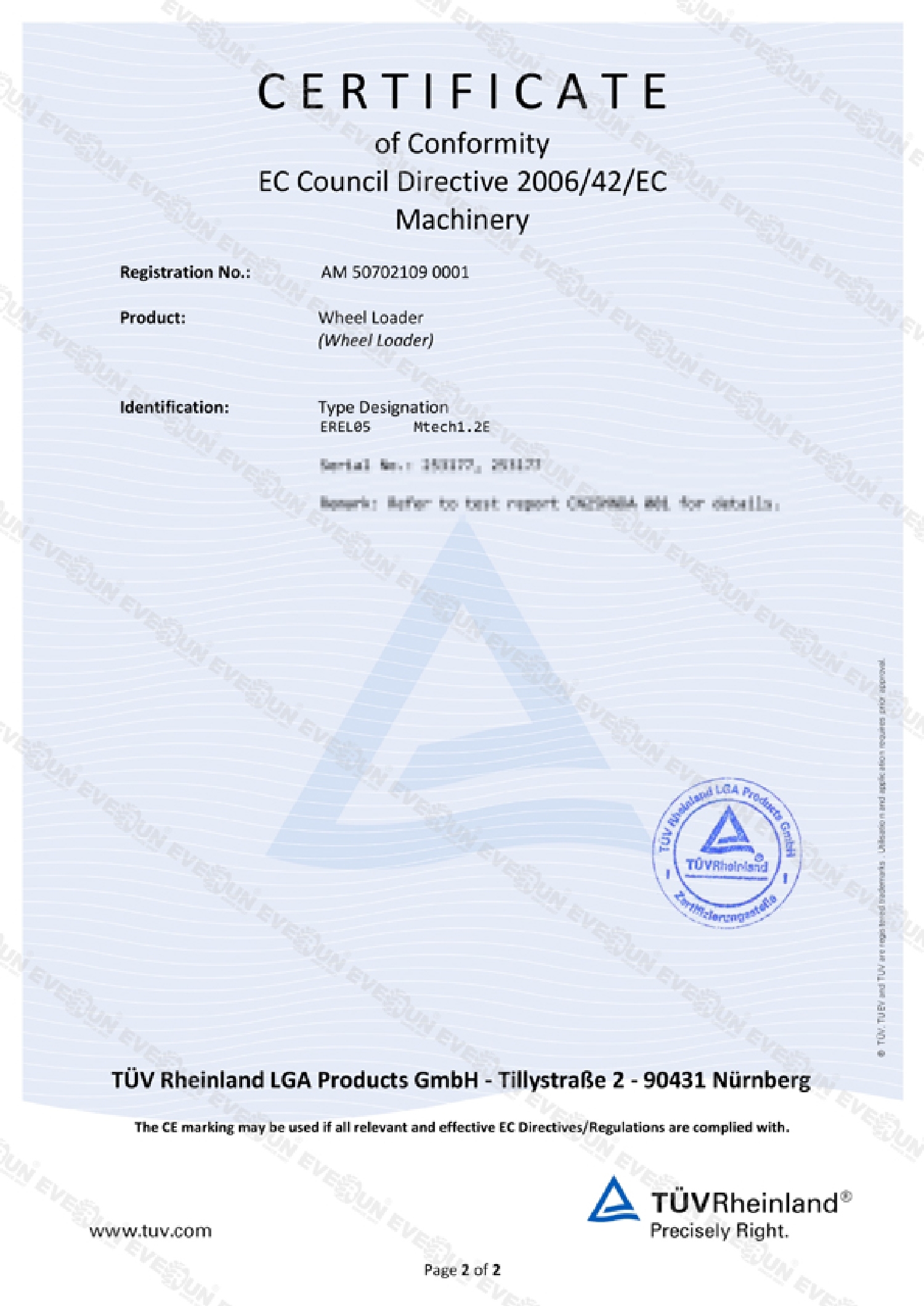
No. Certification attaches to the machine and where it is used, not to how it was financed. In the EU, wheel loaders must comply with EN 474-3:2022, which covers operator stations and ROPS/FOPS protective structures, and machine conformity is declared under Directive 2006/42/EC. EVERUN holds TÜV-issued CE certificates of conformity for models including the ERT1500 (AM 506888210001), EREL1000 (AM 50700694 0001), EREL05 (AM 50702109 0001), ER1220-F (AM 50687892 0001) and ER11HT (AM 50660995 0001). Under a purchase, the buyer holds and maintains that documentation; under a lease or rental, the contract must state which party retains the declaration and service records.
Can a leased or rented wheel loader be customized, or is customization limited to purchase?
Factory customization is a manufacturing capability, and EVERUN offers logo, color and configuration customization with a minimum order quantity of one unit. What changes with the acquisition model is who may authorize it. A purchase lets the buyer specify the machine once and keep that configuration for the life of the asset. A rental machine generally stays in standard fleet specification because it must serve successive users. A lease sits between the two: configuration becomes a contractual matter and should be agreed before the machine is built.
How do I compare total cost across buying, leasing and renting when there is no single published price?
Compare cost structures rather than headline figures. A purchase concentrates cost at the start and spreads it across ownership, while leaving residual value, maintenance and disposal with the buyer. A lease converts acquisition into periodic payments over a fixed term, with maintenance and end-of-term conditions defined in the contract. A rental keeps each commitment short and normally bundles maintenance into the rate, which raises the cost per working period but removes ownership risk. Build three columns, fill them with your own duty-cycle data, and select the structure that matches how long the machine will actually work.
Can I evaluate a machine before committing to a full purchase?
Yes. EVERUN accepts a minimum order quantity of one unit, so a single machine can serve as an evaluation unit instead of a fleet commitment, and every unit undergoes 100% testing before shipment. Acceptance criteria are based on a pre-shipment test, and standard payment terms are 30/70. Buying a single unit is also the most direct way to benchmark a machine against rented equipment working on the same site.
How long does delivery take, and what support follows the machine?
Typical production lead time is 30 days, with monthly production capacity of 500 units. After delivery, EVERUN provides technical support and after-sales service with a 12-hour response commitment, and overseas branches provide local service. Buyers evaluating a purchase can review the EVERUN product catalogue and send the duty cycle to info@everun.com to confirm model fit before committing.
Conclusion: Match the Structure to the Work, Not the Price Tag
Buying, leasing and renting are not competing prices for the same outcome — they are three different allocations of risk. Purchase rewards continuous high utilization and rewards buyers who need configuration control from the first unit. Lease rewards predictable multi-year work where capital is better deployed elsewhere. Rental rewards uncertainty, seasonality and short packages, at the cost of control and availability.
The practical sequence is to measure duration and utilization first, assign maintenance and compliance responsibility second, and only then compare commercial terms. A machine class that suits the application but sits under the wrong acquisition structure will still produce idle capital or missed work. A machine class that fits both — mini, compact, telescopic or electric, sourced from a manufacturer that can support it under any of the three models — is what the decision is really about.
Next Step: Price the Machine Against Your Duty Cycle
Send EVERUN your working months, expected hours and site conditions. The team will confirm which model class fits, what the 30-day production lead time looks like for your configuration, and how a single-unit purchase can be used as an evaluation before a fleet decision.
Catalogue: Download the EVERUN product catalogue (PDF)
Email: info@everun.com | WhatsApp: +86 18661725881 | Web: www.everun.com
Have Questions or Need More Details?
Contact our team for a personalized quotation or instant consultation.
Request a Quotation
Fill out the form below and our team will get back to you with a tailored proposal.
WhatsApp Direct Chat
Prefer to chat in real-time? Message us on WhatsApp for instant assistance & quick answers.
- Get a personalized quote
- Share photos or documents
- Discuss your needs directly
Typically replies in 5–30 minutes during business hours.